One umbrella. Every metric. One answer away.
Why run a subscription for the warehouse, another for the dashboards, another for the semantic layer and another for the AI? Nucleus puts your entire data environment under one umbrella — and lets anyone in the business simply ask it a question.

Your reporting stack grew one tool at a time.
Nobody decided to run six analytics products. It happened one renewal at a time, and now the answer to a simple question sits in four places that disagree.
A BI licence, a warehouse, a reverse-ETL tool, a dashboard viewer seat for every executive, and a spreadsheet that quietly overrides all of them. Each renews separately. None of them agree on last week's hold.
Leadership does not want a chart of net sales by state. They want to know which three locations cost them money last week and what to do about it. That step still runs through an analyst and a two-day queue.
Hold is calculated one way in the board deck, another way in the ops report, and a third way in the sales team's own workbook. Nobody is wrong. Everybody is arguing.
Everything under one roof, reading one definition.
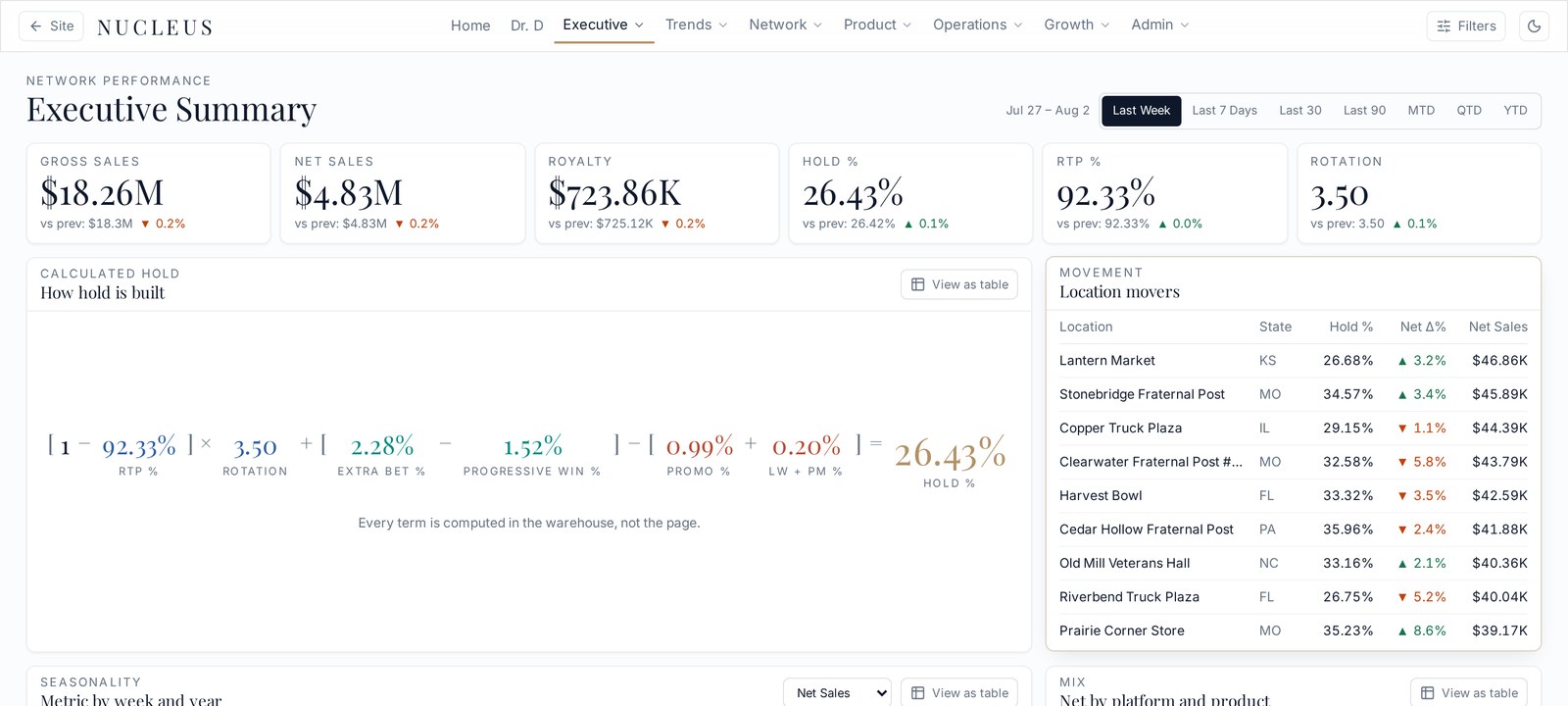
Nucleus collapses the stack into a single governed environment. Every formula lives once, in SQL. Your dashboards read it. Dr. D reads it. When a definition changes, it changes everywhere at the same moment — including in the answer someone gets at eleven at night.
Explore the platformSix things that change on day one.
Every formula — hold, RTP, rotation, net per store per day — is defined once, in SQL, in the warehouse. Dashboards read it. The AI reads it. There is exactly one version of every number.
Ask in plain English. Dr. D writes the query against the same governed views, returns the number with the interpretation, and tells you what it would do next.
Dense, fast, boardroom-grade screens: executive summary, geography, leaderboards, game economics, player retention, promotion design. No scroll hunting.
Holt-Winters forecasts with confidence bands on every location, and a severity-ranked list of what fell outside its band this week — before anyone has to notice.
Role-based access, row-level security, audit logging on every AI question. Read-only query paths. Nothing leaves your governed data estate.
One build, one fee. Modifications on request at a minimal charge. You are buying an asset you own, not a seat count that grows with your headcount.
Every Machine Must Earn Its Place
Every Machine Must Earn Its Place
How casino operators should decide what to keep, move, expand, reconfigure or replace — and why the bottom 10% is not a replacement list.
Seven steps, then it is yours.
Nothing is owed until step five. You can walk away after the written report and keep it.
- 01An intro call
You have seen the product and want to talk. We set up a short call, no preparation required.
- 02Your bottlenecks, in detail
Thirty to forty-five minutes on how the business actually runs, where reporting hurts, and what a good answer would have been worth.
- 03A look under the hood
A second call with your data people: sources, pipelines, reporting cadence, visualisation tools and the KPIs you track today.
- 04A written report and a fixed quote
What is broken, how we would fix it, what your portal would look like, deliverables, timeline and price. No commitment to this point — you can walk away with the report.
- 05Terms agreed, work starts
We settle payment terms, you release the first instalment, and the build begins.
- 06Delivered in stages
Milestones land as the contract sets out, each one reviewed with you so course corrections happen early, not at the end.
- 07Handover and training
Final delivery, a walkthrough for your team, documentation and a working session on the questions they will actually ask.
What people say about working with Shemal.
Shemal was my lead for almost two years. He is highly committed to his work and organizes tasks and responsibilities in a professional manner. He always kept the team motivated. I believe he is one of the best leads I ever had.
Shemal's presence will be felt by any team. An excellent subject expert demonstrated capabilities in handling content and the team. It was a pleasure working with him.
I have had the experience of working with Shemal for almost 7 years in two different organisations. His dedication, technical skills and composure while working during tense situations are exemplary.
The questions executives actually ask.
Why one platform instead of a warehouse plus a BI tool plus a viewer licence?
Because the seams are where the cost and the disagreement live. Every tool you add is another place a definition can drift and another renewal on the card. Nucleus keeps the metric layer, the dashboards and the AI answer layer in one governed environment, so a number means the same thing everywhere it appears.
We already run Power BI. Do we have to rip it out?
No. Nucleus can read the same warehouse and run alongside your existing reporting while the metric layer is reconciled. Most clients keep Power BI for operational detail during the first quarter and move executive reporting into Nucleus once the numbers tie out.
How is this cheaper than a subscription?
There is no monthly platform fee. You pay once for the build and you own it. Modifications and new dashboards are charged as small, discrete requests. Nothing scales with how many people log in.
How accurate is the AI? Can it invent a number?
It cannot. Dr. D does not generate figures — it writes a read-only query against the same governed views the dashboards use, and reports what comes back. If a question cannot be answered from the metric layer, it says so instead of guessing.
What stops it from running something destructive?
The query path is read-only at the database level. Write, DDL and system-schema statements are rejected before execution, results are row-capped, and there is a statement timeout. Every question and the SQL it produced is logged.
Where does our data live?
In your environment. Nucleus is deployed against your warehouse with row-level security and role-based access. We do not copy your data into a shared multi-tenant store, and no raw records are used to train anything.
Who can see what?
Access is role-based and enforced in the database, not in the UI. A regional manager sees their region in the dashboards and gets the same restriction when they ask the assistant a question.
How long does onboarding take?
A focused Essentials build is typically four to six weeks from data access to handover. A full Operator deployment usually runs eight to twelve, depending on how many source systems have to be reconciled.
What can you connect to?
SQL Server, Oracle, Postgres, MySQL, Snowflake, BigQuery, flat-file and API sources, plus existing Power BI semantic models. If it can be queried or exported on a schedule, it can be modelled.
What does support look like after handover?
You own the build outright. New dashboards, new metrics and changes to existing logic are quoted per request at a minimal charge, with a priority lane available for Enterprise clients.